

Share Box
Keeping your online community active and engaged isn’t easy. You can have great content, useful discussions, and even a well-designed platform — but without the right motivation, your members may still lose interest.
That’s where point-based reward systems come in.
By assigning points for meaningful actions — like posting, commenting, or helping others — you turn everyday engagement into a game-like experience that taps into people’s natural drive for recognition, progress, and rewards.
In this guide, we’ll break down how to create a points system that actually works:
- What kind of actions should earn points?
- How do you keep it fair and motivating?
- What should members be able to do with their points?
Whether you run a niche creator community, a brand-led forum, or a learning-based tribe — this guide will help you build a point system that motivates members and grows your community.
What Is a Point-Based Reward System?
A point-based reward system is a gamification mechanic where members earn points for performing specific actions within a community. These points can accumulate over time and be used to unlock badges, privileges, or tangible rewards.
This system helps translate everyday actions (posting, replying, attending events) into measurable achievements. It provides an alternative currency in your community that reflects a member’s value and activity level.
Unlike passive membership models, a point-based structure promotes active participation, goal setting, and peer recognition, creating a vibrant, self-sustaining ecosystem.
Why Do Point Systems Work?
Because they tap into intrinsic and extrinsic motivators that govern human behavior:
- Progress tracking: Humans are naturally goal oriented. Seeing points go up after each action reinforces positive behavior and encourages continuation.
- Status and recognition: Points can signal reputation or expertise. Members want to be seen as valuable contributors.
- Unlockable rewards: Whether it’s access to exclusive content or community perks, points act as a form of delayed gratification.
- Sense of fairness: Everyone starts at zero. A transparent point system ensures recognition is based on effort, not just popularity.
A well-designed point system gives members a reason to log in regularly, contribute meaningfully, and support the growth of the community.
What Actions Should Earn Points?
The point system should reward behaviors that align with your community’s goals. Think beyond vanity metrics and focus on what truly contributes to your ecosystem.
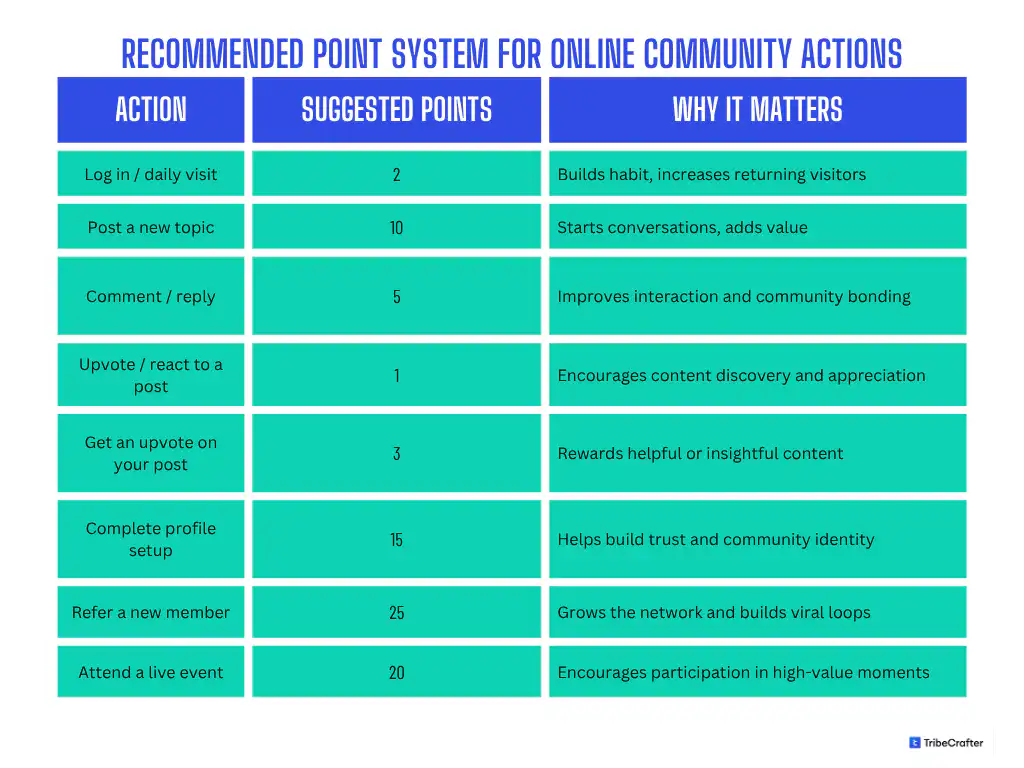
Pro tip: Use weighted values. Not every action deserves equal recognition. Give higher points to harder or more valuable contributions.
How to Set Up a Reward System for Your Community That Works
Setting up a point system isn’t just about assigning numbers. It requires strategy and alignment with your community vision.
Define your goal
What outcomes are you hoping to achieve with a point-based reward system in your online community? Is your aim to increase member retention? Boost user-generated content? Encourage collaboration?
Your point logic should reflect these goals.
Map actions to outcomes
Assign points to actions that help you reach your goal. For example, if your priority is peer support, replying to questions should earn more points than passive activities.
Assign fair values
Avoid inflating points for basic tasks (like logging in) and ensure more effortful actions are properly rewarded. You can also use decay mechanisms where points drop over time to keep engagement ongoing.
Create milestones and tiers
Introduce thresholds or levels where users unlock new perks or roles. This adds progression and keeps engagement high.
Reward both short-term and long-term engagement
Some actions should yield instant points (posting), while others could be streak-based or milestone-based (e.g., 30-day login streak).
Test and iterate
Monitor what’s working. Are users gaming the system? Are your top contributors genuinely helping others? Refine your strategy accordingly.
What Can Members Do With Points?
The best point systems tie directly to tangible or meaningful rewards. These can be:
Non-monetary perks:
- Unlock access to hidden groups or premium content
- Appear on public or private leaderboards
- Earn badges, flair, or rank titles
- Receive shoutouts in newsletters or events
- Qualify for early access to features
Tangible/monetary rewards:
- Redeem merchandise or discount codes
- Gift cards or wallet credit
- Book a free consult, session, or service
- Receive exclusive invites (webinars, meetups, beta tests)
Allowing users to choose how they spend their points (like in a reward store) increases motivation by giving them autonomy and purpose.
Common Mistakes to Avoid
- Over-rewarding passive actions: If members earn too many points for logins or likes, they won’t feel the need to actually contribute.
- No use for points: Earning points with no outcome leads to drop-offs. Always link them to something actionable.
- Reward farming: Watch for abuse like spam posts or low-effort replies done solely for points.
- Unclear rules: Make point logic transparent. Let users know how points are earned, tracked, and spent.
- No progression system: Flat systems get boring. Add tiers, levels, or time-bound achievements to maintain excitement.
Tools & Platforms That Can Help
Whatever platform you’re on, look for the ability to:
- Define custom point rules and action triggers
- Automate badge unlocks and role changes as members hit thresholds
- Display point totals on member profiles or a dashboard
- Tie point milestones to real perks, like access unlocks or membership upgrades
Keep one thing in mind, the more customizable the platform, the more flexibility you’ll have to design a system that actually fits your community.
Real Examples of Point Based Rewards in Online Communities
- Reddit Karma: Reputation system with no real rewards, yet widely respected and influential.
- Duolingo XP: Tracks learning progress and encourages daily activity with streaks and leaderboards.
- StackOverflow Reputation: Tied to privileges like editing posts, flagging, and moderation roles.
These platforms prove that points don’t need to be transactional — they can be used for trust-building, influence, and long-term engagement.
Point-Based Reward Systems – FAQs
Q: How many points should common actions be worth?
A: There’s no universal number, but the principle that matters is relative weighting: a thoughtful reply should earn more than a like, and a genuinely helpful answer should earn more than a routine post. Start rough, watch what happens, and adjust.
Q: Should points ever expire?
A: For some communities, yes. A decay mechanism, where points slowly drop if a member goes inactive, keeps the leaderboard reflecting who’s actually engaged right now rather than who showed up once, months ago, and never came back.
Q: Can a point system backfire?
A: It can, mainly by rewarding the wrong behavior. If low-effort actions like logging in or leaving a one-word comment earn too much, members chase the points instead of contributing anything useful.
Q: Do small communities need a point system at all?
A: Not always. A community under a hundred active members often runs fine on recognition and relationships alone. Points tend to earn their keep once a community gets too large for you to notice every valuable contribution yourself.
Wrapping Up
Point-based reward systems are more than a gimmick. They’re a proven framework for nurturing long-term engagement, loyalty, and community health.
By rewarding the right behaviors and giving members a reason to return, you’re building a community that doesn’t just consume content — it creates, collaborates, and thrives.
Up Next:
Want to go deeper into gamification? Check out our complete guide to community gamification — covering badges, leaderboards, streaks, and more.
Whatever platform you choose, the core idea holds: reward the actions that actually matter to your community, keep the rules transparent, and adjust as you learn what motivates your members.
Of course, a reward system only works if you’ve got a solid community to build it on top of. If you’re still choosing where to host yours, TribeCrafter is an all-in-one community platform that combines groups, courses, events, a blog, and monetization tools in a single product.
See how it works and start building your community today.
Ready to build your community?
Help shape TribeCrafter. Build and monetize your community, and tell us what you need next.
No credit card required
Weekly Insights
Get the best community growth
strategies delivered to your inbox.
-
- Guides
- ·
- Insights
15 Virtual Event Engagement Ideas That Actually Work
Virtual event engagement refers to how actively participants interact during an online event — joining discussions, responding to polls, asking questions, and staying attentive throughout the session, rather than passively watching. Virtual events are everywhere, but keeping people engaged is still a challenge. If your attendees are zoning out, multitasking, or dropping off halfway, you’re […] -
- Insights
9 Major Disadvantages of Facebook Groups You Should Know
Facebook group is the first thought that comes to one’s mind, when thinking of starting an online community. Facebook is free and has millions of users, so it naturally gets tempting to create an online community there. However, in reality Facebook groups do have many limitations and disadvantages which may interrupt effective community management and […] -
- Guides
What is an Online Community? Definition, Benefits & Examples
An online community is a group of people — also called a virtual community or digital community — who connect, communicate, and support each other online around a shared interest, goal, or brand, without needing to be in the same physical place. “Brands should think of themselves not as storytellers but story builders. We plant […]