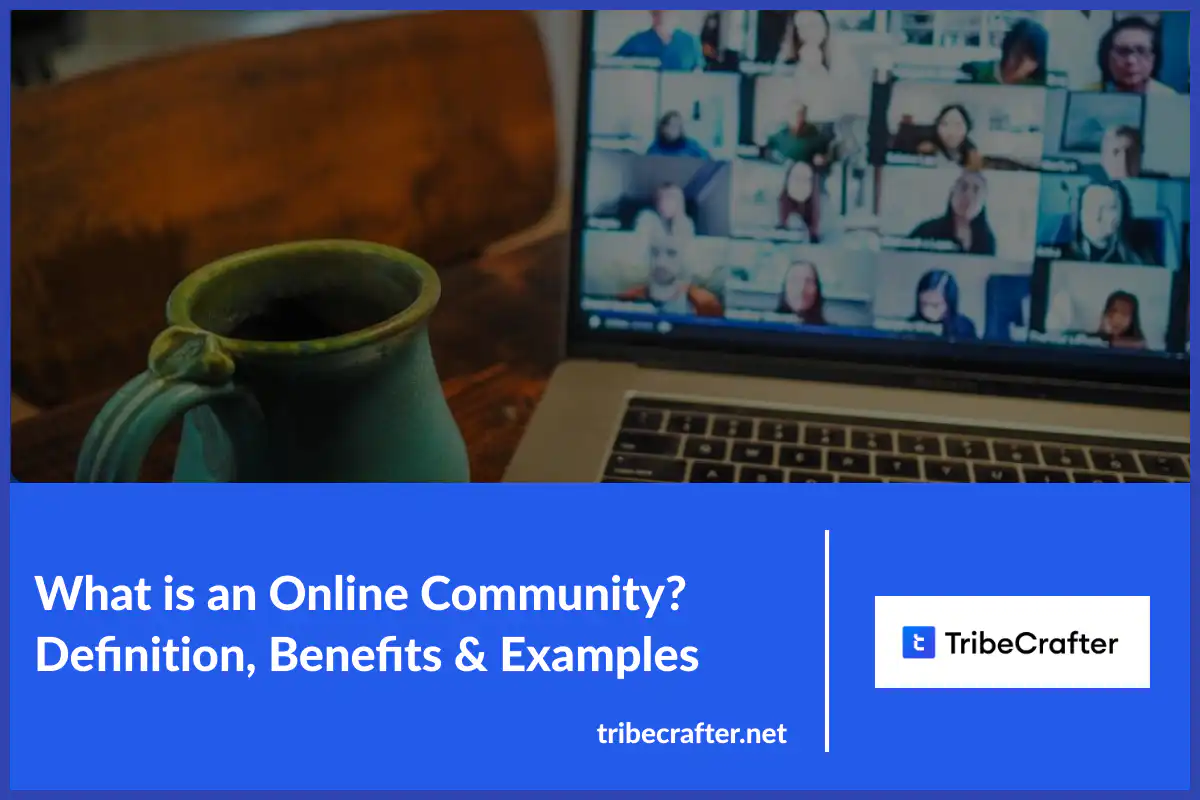
What is an Online Community? Definition, Benefits & Examples

Anum B
Head of Content
16 min read

Head of Content
“Brands should think of themselves not as storytellers but story builders. We plant seeds of content and let our community build on it.”
– Amy Pascal, Business Executive and Film Producer
In today’s digital-first world, online community is no longer optional, it’s strategic. For coaches running paid courses, businesses launching new products, or even agencies managing client relationships, online communities are becoming powerful growth engines. They help businesses build deeper relationships, increase retention, and create long-term brand loyalty.
As internet usage continues to grow, more people are turning to digital spaces to connect, learn, and collaborate. According to a report by Global Web Index, 76% of internet users participate in online communities, engaging in forums, blogs, and groups across various devices.
But what exactly is an online community and why are so many businesses investing in them? Let’s discuss that in detail.
In this guide, you will learn:
A group of people who communicate online over a common interest, problem, or objective is called an online community. Without physically meeting, people who share a sense of belonging utilize these communities to study, grow their networks, share knowledge, or discuss their interests.
A professional network that unites individuals around a common, organization-based experience to promote broad online collaboration and growth is known as a branded online community. Your company can link members, clients, staff, partners, and any other audience it wishes to reach with this kind of community.
Branded online communities are very important to your members’ experiences. To give greater value, they dismantle the conventional one-way information flow and open up communication.
For businesses that want full ownership and customization, dedicated community platforms like TribeCrafter allow you to create a fully branded, private community; without relying on third-party algorithms or limited social media features.
Branded online communities come in a variety of forms. One of the primary distinctions between them is whether they are searchable and public, private (accessible only with an invite or login required), or hybrid having some public components but requiring a login to access them all.
The number of people who may profit from the information is maximized in open communities because anyone can view the talks that take place. The membership and contribution requirements for these groups are typically somewhat loose.
Open communities are like the Public Subreddits which means group’s material is visible to everyone. Making a contribution is as easy as creating an account and selecting the appropriate community to join.
Although this slows down community growth, it makes it simpler for leaders to steer conversations in the right direction. Members of closed communities frequently derive great benefits from them.
Usually, people confuse large social media networks such as Facebook and LinkedIn with online communities. Although both the types may have some similarities such as a common goal of connecting people online.
However, the major difference lies in the core functionality and features of the strategies behind targeting the audience.
The lack of ownership is one of the biggest limitations of social media communities. This is where a private community platform like TribeCrafter shines. Unlike social media groups, TribeCrafter gives you full control over branding, privacy, member access, and engagement tools. All in one customizable platform designed to grow your private community effectively.
I recommend using a private community for your business instead of social media networks for a number of reasons:
The privacy of the community and its members are the top priority of these private online community platforms. Social media platforms like Facebook or LinkedIn offer limited control over the privacy of both members and the community owners.
Moreover, when you are part of any open source platform, you will have limited control over how the users’ or your own data is used. This may lead to various security concerns such as data hacking.
One such example of a massive security breach is the famous Facebook data breach that occurred in 2021 where the personal information data of around 533 million Facebook users was leaked.
Being a community owner at a social networking site, you are bound to follow the rules set by these networks. So, every time there is a new regulation, you will have no other choice but to follow the changes with no autonomy.
Most of the community platforms, such as TribeCrafter, offer powerful community management tools that further simplifies the hassle of managing your communities. These tools are designed to give community owners full control over their platform’s configuration, members, content, and monetization.
Unlike social media communities, private community platforms allow you to have complete access to the community data. You can monitor this data and track the overall performance of your community in terms of engagement. Hence, access to your community data helps you track the progress of your community towards the specified business goals.
With Nike Run Club, running becomes more than just a solo activity. It turns into a shared experience. Members join challenges, track progress, earn rewards, and stay consistent through a sense of community.
This isn’t just about engagement. It’s part of a much bigger system. Nike has built a digital ecosystem with over 160 million members across its apps. And the company has repeatedly highlighted that more engaged members especially those using multiple touchpoints buy more often and stay longer.
Apps like Nike Run Club play a key role here. They keep users coming back, not through ads, but through community-driven motivation. Over time, that consistent engagement translates into stronger customer relationships and higher lifetime value.
That’s the real impact of community it doesn’t just attract users; it keeps them.
One of the largest tech enterprises, Apple, needs no introduction. Its users can share their experiences and receive peer-to-peer support through its extensive discussion forum. The Apple Support Community includes a number of interactive features and lets them hang out electronically as well. Apple community mainly uses reputation levels, badges and recognition.
Apple built its support community to scale support through its users. Instead of handling every issue internally, users help each other solve problems. This reduces pressure on support teams while building a group of highly engaged, knowledgeable customers.
Buffer’s community story is really a story about what radical transparency can build. Since 2013, Buffer has publicly shared everything: employee salaries, revenue figures, churn rates, and even equity breakdowns.
This resulted in creating a community of users, creators, and founders who felt genuinely invested in Buffer’s journey, not just its product.
According to Ravio, when Buffer published its open salary database, they immediately saw a 229% increase in job applications, which is a proof that community built on trust attracts the right people at scale. And the business results followed. Data from Buffer’s December 2025 shareholder update shows that it closed 2025 with annual revenue of $22.46M, a 31% year-over-year increase which is their strongest revenue results in company history.
Today, Buffer serves over 190,000 creators, small businesses, and marketers every month, and invites users to actively shape what gets built by joining their Discord community.
Their community isn’t a support forum; it’s a feedback loop that directly drives product decisions.
Private online communities can help your business expand in many ways. They boost member or customer loyalty and revenue in addition to helping organizations as a whole.
For course creators and businesses, these benefits translate into tangible business outcomes, such as recurring revenue, higher client retention, reduced support costs and stronger brand loyalty.
Let’s discuss in detail the benefits of online communities:
Online communities create two-way communication. Instead of just broadcasting content, businesses can have real conversations with members.
This consistent interaction strengthens relationships and increases long-term loyalty.
With online communities, nurturing your prospects and generating leads become easy. Coaches and consultants can encourage the prospects inside their community before offering paid programs.
The kind of online community you build will determine how quickly you can persuade potential buyers to purchase your goods. Additionally, it might motivate current clients to make additional purchases.
Every post, comment, and shared experience contributes to brand visibility.
When members actively participate, they amplify your brand message organically. This reduces dependency on paid advertising and improves word-of-mouth growth.
Agencies and SaaS brands can build credibility by answering questions publicly and transparently inside their community. 85% of brand owners state that having a branded online community builds greater trust among their audience. In the current digital world, connecting and interacting with customers, prospects, and audiences has almost become a need for businesses.
A branded online community allows members to share experiences, testimonials, and insights publicly, building social proof naturally.
Communities provide direct access to customer feedback.
You can learn:
Specifically for SaaS companies, this can directly influence product development.
If you’re an educator, startup, or a business looking to build a private, branded community with full control over your data and member experience, platforms like TribeCrafter make it easy to launch and manage your community without technical complexity.
Online communities are especially powerful for:
Coaches can create private membership communities to deliver courses, host Q&A sessions, share resources, and build recurring revenue through subscription plans.
Startups use online communities to reduce support tickets, collect product feedback, improve onboarding, and increase customer retention.
Agencies can build multiple private client communities to centralize communication, share reports, provide updates, and strengthen long-term client relationships.
Online communities may vary depending upon the type of business, their goals, structure or mode of moderation or management. While each type of community has its own key features, it is also worth noting that a specific community can come under more than one type of community.
Following are some of the community types that should be considered important to discuss:
If you want to explore more about the types of community, check out our blog about types of online communities.
Community engagement refers to the interaction and involvement of the members of your virtual community. This involves actionable steps to encourage members’ activity and connections that encourage them to participate in the community.
Needless to say, that the higher the community engagement the better.
Before formulating a successful community engagement strategy, you should keep in mind that each strategy should align with the specific business goals. In other words, the engagement practices that you intend to apply for your customer community might not be suitable for someone with a non-profit community.
Following are some of the practical ideas that will help you boost your community engagement:
While creating an online community for your organization, it is mandatory to have a set of goals in your mind that you want to achieve with the community.
For example, a startup building a product-led community will focus on user education and feature discussions, while a coach running a membership community will prioritize peer interaction and accountability.
With the right community managers team, you can make it thrive effectively.
You can either hire a new team or select from the existing ones. Make sure to hire someone who has a knack for social media or running online communities and has in-depth knowledge of your brand’s vision.
Taking inspiration from your competitors and their growth strategy is a great way to effectively run and grow your online community. This method will broaden your perspective and give you a new understanding of how to grow your community.
There is no point in having a virtual community, if there is zero or minimum community interaction.
In order to productively grow your community, you should set up an excellent community engagement strategy.
Community moderators are the people who make sure that the community rules are implemented and followed by the members. Their key role is to go through all content posted on the community to ensure that it aligns with the community guidelines and regulations.
If any community rule is broken, then it is the moderators’ job to take the necessary actions. These actions may include practices such as removing the content, muting the member or in some cases permanently removing him from the community.
Apart from monitoring the activities of existing members, moderators also take care of who can join the community.
Read more about how to moderate an online community on our blog.
There are tons of matrices that you can measure in your community. However, there are only a few that are truly responsible for impacting the KPIs of the community. This is because only a small number of engagement measures will enable you to determine whether the objectives of your particular community are being reached.
The community engagement rate (CER) tells us the percentage of community members that have interacted with others in any way.
Community engagement rate is calculated by dividing the number of community members engaged with the total number of community members.
Active members and contributing users: As the name suggests, active members refer to the number of people actively participating in the community. You can monitor daily active users (DAU), weekly active users (WAU) and monthly active users (MAU).
Just like active users, it is crucial to monitor contributing users. You may get a glimpse of how many members of your community are participating (and how many aren’t) by comparing the number of active users with the number of contributing users.
Member growth: Member growth is the amount of new members added to your community in a specific period of time.
Your community’s membership growth rate also tells you about the popularity of your virtual community.
For businesses looking to build deeper relationships with their audience, an online community is more than a communication tool, it’s a strategic growth asset. Online communities are the easiest way to promote communication with your intended market, customers, stakeholders, etc. Online communities can be launched as private, branded communities or on social media networks.
While private online communities offer greater advantages in terms of management, moderating, and forum control, social media platforms are still suitable for novice users. Virtual communities have a number of noteworthy advantages and can provide you with valuable customer data. It is an excellent way to interact with your audience directly and it makes business growth simple.
Now that you understand what an online community is and how it can benefit your business, the next step is implementation.
If you’re ready to move beyond social media groups and build a fully branded, private digital community, TribeCrafter gives you:
Create your online community with TribeCrafter today.
A: Online communities help people connect, share knowledge, and support each other around a common interest, industry, or goal.
A: The main types include:
A: To start an online community:
A: They provide:
A: Businesses use online communities to:
Join 5,000+ creators who are building
and monetizing their tribes with
TribeCrafter.
No credit card required
Get the best community growth
strategies delivered to your inbox.