Book a call
30 minutes on Google Meet. A demo, pricing, moving over from BuddyBoss or another platform, or any question you have.
Prefer to write? Send us a message

Every 1:1 coach reaches the same point eventually. Your calendar is full, clients are getting results, and your income has stopped growing because there are no more hours to sell.
Coaching keeps growing. The International Coaching Federation counted 122,974 coach practitioners in its 2025 Global Coaching Study.
The good news is that you don’t need more hours. You need a group coaching program: one coach, one shared goal and a small group of clients working through it together.
In this guide, you’ll learn how group coaching compares with 1:1 work, what the research says about whether it works, and how to create a group coaching program in seven steps. You’ll also get practical tips for running sessions people actually finish. If you’re still at the very beginning, start with our guide on how to start a coaching business and come back when your calendar fills up.
A group coaching program is a structured program where one coach guides a small group of clients toward the same outcome. Members meet regularly on live calls, work through shared material and support each other between sessions.
In a course, people learn alone. In a free community, there’s no set goal. A group program sits between the two: people learn together, toward one result, by a set date.
Most group programs follow a simple rhythm. Each week, members work through a topic, join a live call and apply what they learned before the next session.
On the call, the coach teaches briefly, then coaches individual members while the rest of the group listens. Hearing someone else’s problem solved is often as useful as having your own solved, because members face similar challenges.
Between calls, the group stays connected in a shared online space. Members post questions, share wins and keep each other accountable.
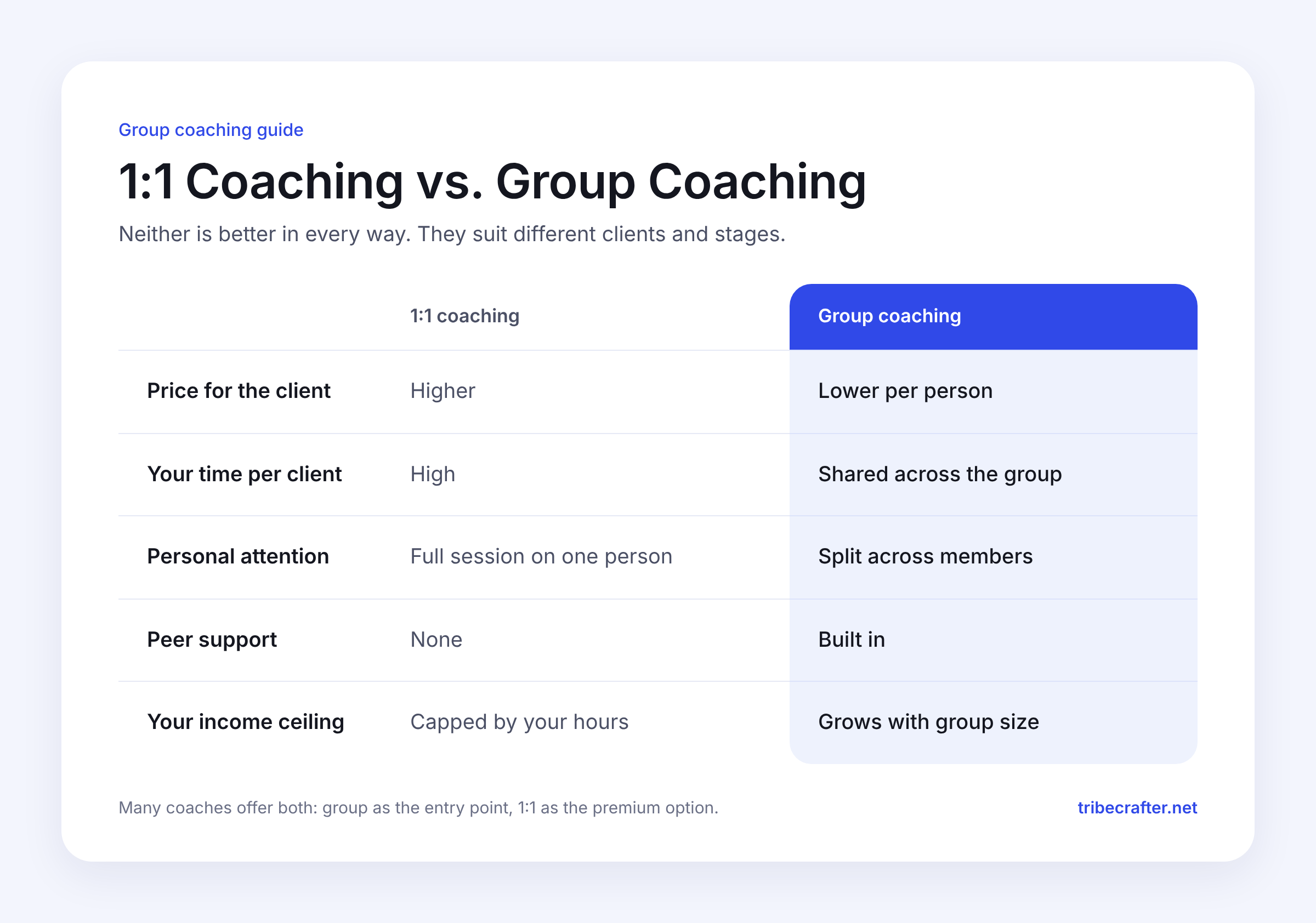
Group coaching works, though it works differently from 1:1 coaching. The research is useful here because it shows where each format is strongest.
In a randomized study published in the Journal of Applied Behavioral Science, researchers compared 1:1 coaching, group coaching and no coaching with 108 participants. Both coaching formats helped people reach their goals more effectively than no coaching. The 1:1 participants showed a bigger increase in goal commitment and motivation, which the researchers linked to how the coach led each session.
Group coaching has its own strength: the connections people make. A 2025 study in the International Journal of Evidence Based Coaching and Mentoring found that women who took part in group coaching built significantly stronger professional networks than women who weren’t coached. They were also more likely to receive a pay rise.
In short, group coaching gets people results, and it adds peer support that 1:1 can’t. Strong leadership from you as the coach still matters a lot, which is why the structure in the next section is worth getting right.
You don’t need to have every detail perfect before your first group. Use these steps to build a solid first version, then improve it with each round.
A group coaching program sells on its promise. “Get clarity and grow” is too vague. “Land your first three paying clients in eight weeks” is specific enough that people know whether it’s for them.
Look at your 1:1 work for the result clients ask about most often. That’s usually your best program outcome.
Your group needs to be small enough that everyone gets attention on calls, and big enough that the conversations stay lively. A good starting point is 6 to 12 people.
For length, match the program to the outcome. A focused skill might take four to six weeks. A bigger change, like building a business or a new habit, often needs eight to twelve. Shorter programs are easier to fill and easier to finish, so start there if you’re unsure.
You’ve probably already built a curriculum without noticing. Look at the order in which you usually work with private clients: what you cover first, what comes next and where people tend to get stuck.
Turn each stage into a weekly topic. For each week, plan one short lesson, one exercise and one question to discuss on the live call. Keep lessons brief. The live calls are where most of the progress happens.
Most strong group calls mix three parts:
Keep the same structure every week. Members know what to expect, and you spend less time planning each session.
Group coaching should cost less per person than your 1:1 rate, while earning you more per hour overall.
This matches where the coaching industry is heading. In ICF’s 2025 research, most coaches said they expect future growth to come from more clients and more sessions rather than from raising fees. A group program is the most direct way to serve more clients without working more hours.
To set your price, work out what you’d earn for the same hours in 1:1 sessions, then divide by your group size. Set your group price a little below each person’s share of that 1:1 cost. For example, if eight weeks of 1:1 calls would earn you a certain amount, a group of ten at a lower per-person price can still match or beat it.
Your group needs one home for everything: the lessons, the call details and the conversation between sessions. When they’re spread across email, a chat app and a shared folder, people lose track and drift off.
A community platform keeps it in one place. On TribeCrafter, you can create a paid private group for each program, put your weekly lessons in a course with progress tracking, and add each live call as an event with your video meeting link. Events don’t repeat automatically, so create one event for each call.
TribeCrafter is an all-in-one community platform that combines groups, courses, events, a blog, and monetization tools in a single product. You can sell access through a one-time product or a recurring plan, with payments going straight to your own Stripe account. Include both the group and the course in the same product or plan, so members get the whole program with one purchase.
Two practical tips:
Your first members will almost always come from people who already know your work. Start with your current and past 1:1 clients, then your email list and social followers.
Open a waitlist before you announce a start date. It tells you whether there’s enough interest, and it gives you a warm list to email when enrollment opens. For your very first group, consider a lower launch price in exchange for detailed feedback and a testimonial.
Filling your program is the easy part. Keeping people engaged until the last session is harder, and it matters more: members who finish get results, and they’re the ones who sign up again.
The first week sets the tone. Send a welcome message, ask everyone to introduce themselves in the group and explain exactly how the program works. These new member onboarding ideas work just as well for a coaching group as for a larger community.
A call where only you talk feels like a webinar. Ask questions early, call on members by name and use breakout rooms for small discussions if your video tool supports them. These ideas for engaging live sessions can help you mix things up.
Record every call and add the recording afterwards, so members who miss a session can still catch up.
Most of the accountability in a group program happens between calls. Post a weekly prompt, start a “wins of the week” thread and reply to questions quickly in the first few weeks, while habits are forming.
When members start answering each other’s questions, your group is working.
Don’t let your best members simply disappear on the last day. Offer a next step: another round of the program, a more advanced group or ongoing access to a paid community. These member retention strategies can help you keep alumni engaged long after the program ends.
If you’re not sure what your first program should be, these ideas show how a clear outcome turns into a group offer:
Pick the idea closest to the results you already get for 1:1 clients. A program built on proven work is much easier to sell.
For many coaches, a group coaching program is the way past a full calendar. You help more people in the same hours, and your clients get something 1:1 sessions can’t give them: a group of people working toward the same goal.
Start small. Choose one outcome, invite your existing clients and run your first group with a simple weekly rhythm. You’ll learn more from running one round than from planning three.
When you’re ready to set it up, TribeCrafter gives you one place for your group, your lessons and your live calls. Explore TribeCrafter for coaches and start building your first program.
A good starting point is 6 to 12 people. That’s small enough for everyone to get attention on live calls, and big enough to keep discussions active.
If your program relies heavily on hot-seat coaching, stay toward the smaller end. If it’s more teaching-led, you can take a larger group. Start small for your first round and adjust once you see how the calls feel.
Charge less per person than your 1:1 rate, but enough that the whole group earns you more per hour than private sessions would.
A simple method is to work out what the same hours would earn you in 1:1 coaching, divide that by your group size, and price slightly below each person’s share. Raise your price for later rounds as you collect results and testimonials.
Most group coaching programs run between four and twelve weeks. The right length depends on your outcome. A single skill can fit into four to six weeks, while bigger changes usually need eight to twelve.
Shorter programs are easier to sell and more people finish them. If you’re unsure, start with six weeks and lengthen it later if members need more time.
Yes, and many coaches do. Group coaching works well as an entry-level offer, while 1:1 coaching stays a premium option for clients who want personal attention.
Running both also gives you a natural upgrade path. Group members who want deeper support can move into 1:1, and 1:1 clients who finish their sessions can join a group to keep their momentum going.
Help shape TribeCrafter. Build and monetize your community, and tell us what you need next.
No credit card required
Get the best community growth
strategies delivered to your inbox.